From Labor-Intensive to Skill-Intensive: Transforming India’s Manufacturing Workforce
India’s factories are standing at a turning point—cheap labor alone can no longer drive growth. This blog explores the urgent shift from labor-intensive to skill-intensive manufacturing, why the old model is failing, and how skilling, technology, and sustainability can unlock India’s $1 trillion manufacturing vision. With real examples and practical solutions, it highlights how initiatives like those at Ananta Mitra Foundation are preparing workers to thrive in Industry 4.0.
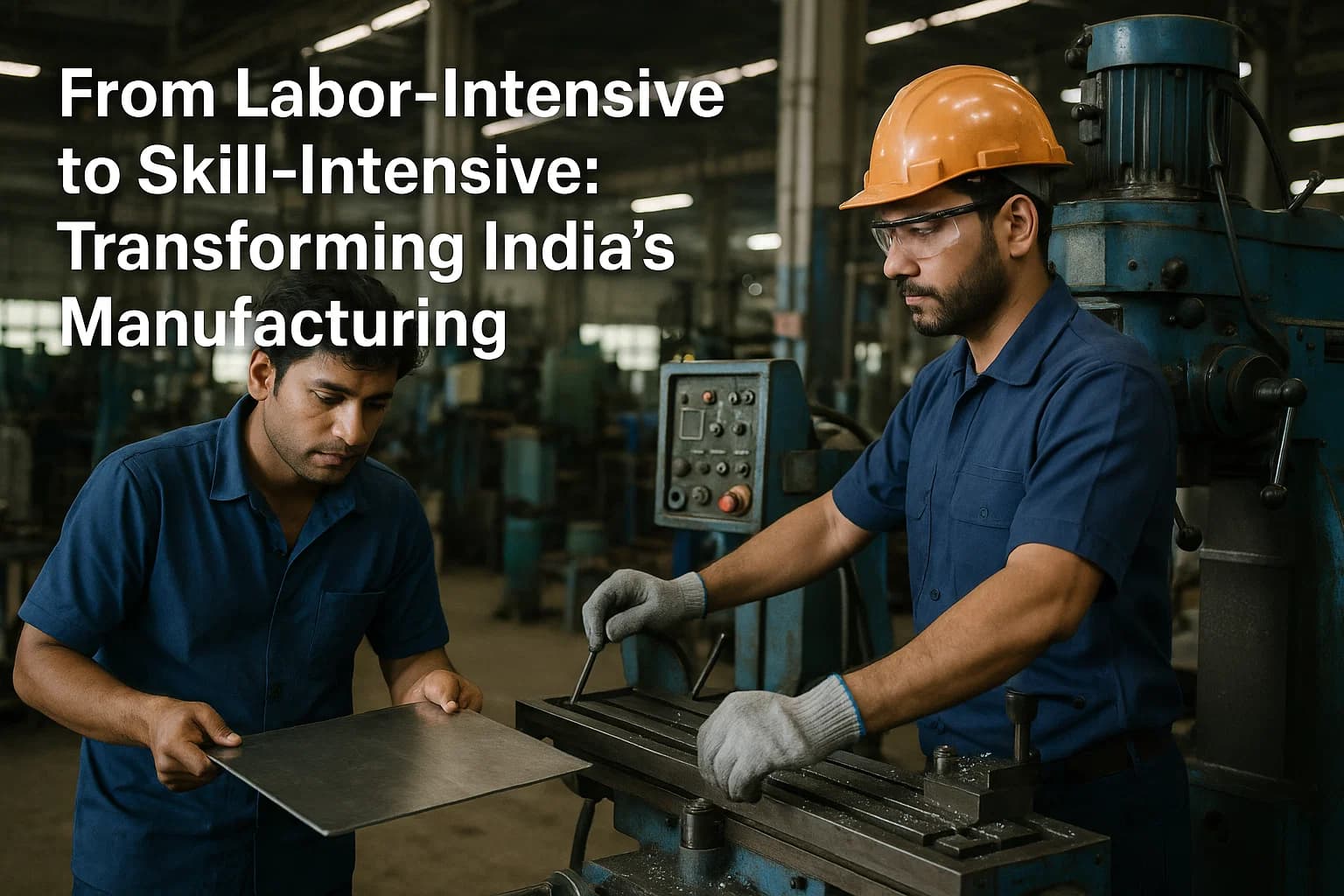
Walk into a factory in India today and you’ll notice two different worlds under the same roof. On one side, rows of workers performing repetitive manual tasks—cutting, stitching, packing, lifting. It looks very similar to how Indian factories operated decades ago. On the other side, you may see robotic arms assembling parts, with mathematical precision, or AI-powered every defect invisible to the human eye.
This is the paradox of Indian manufacturing today. We have one of the world’s largest workforces, but we also face the urgent need to upgrade skills, adopt advanced technology, and compete in a fast-changing global market.
The truth is simple: the era of competing only on cheap labor is over.
Global buyers today want more than low prices. They expect accuracy, faster deliveries, zero defects, and sustainable practices. These demands cannot be met with muscle alone. They require skills, knowledge, and the ability to work with modern machines.
The real question for India is no longer “Should we move from labor-intensive to skill-intensive manufacturing?” but “How fast can we make this transition?”
Why the Old Model Can’t Take Us Forward
For many decades, India’s advantage in manufacturing was its low-cost labor. But that model is now breaking down. Here’s why:
1. Productivity Gap
Studies show that compared to workers in China or Vietnam, an Indian worker often produces less per hour. This is not because Indian workers are lazy or unwilling. It is because they are not given the right skills, tools, and environment. A worker can only do so much with outdated machines or without proper training.
2. Quality as a Survival Factor
Global markets today are unforgiving. A single major defect can lead to an entire shipment being rejected. Rejections cost money, damage reputations, and make buyers switch to competitors. Skilled workers are the backbone of quality—people who can troubleshoot, maintain machines properly, and ensure zero-defect production.
3. Technology Divide
Industry 4.0—smart factories, AI, IoT sensors, and automation—is already reality across the world. Machines today can self-correct, predict maintenance, and optimize processes. But if the people operating these machines are untrained, then crores of rupees invested in technology go wasted.
4. Pressure of Sustainability
Manufacturers now face strict environmental rules: Zero Liquid Discharge in textiles, emission norms in automotive, waste segregation in ceramics. Customers are asking for eco-friendly processes. Meeting these demands requires workers who understand science, compliance, and sustainability—not just manual effort.
To continue with a labor-heavy, low-skill model is like trying to win a Formula One race with a bullock cart. It may move, but it will never win.
What a Skill-Driven Factory Looks Like
The fear many people have is: “If factories adopt robots and automation, will people lose jobs?” The reality is the opposite. A skill-driven factory is not about replacing people—it’s about upgrading them.
Here’s how roles change in a modern, skill-intensive factory:
- Machine Operators become Diagnosticians: Instead of just pressing buttons, they read machine data, predict breakdowns, and fine-tune performance.
Supervisors become Data Analysts: They don’t just walk around; they monitor dashboards, track real-time efficiency, and adjust workflows instantly.
Technicians become Multi-Skilled Experts: They can shift between running a CNC machine, checking quality with precision tools, and fixing faults real time. - Workers become Eco-Literate: They understand how energy, water, and waste management affect costs, compliance, and brand reputation.
So the factory of the future is not silent halls filled only with robots. It is a place where humans and technology work together—where people’s intelligence amplifies the power of machines.
Roadblocks to This Transition
Of course, moving from labor-intensive to skill-intensive manufacturing is not simple. There are many challenges India must overcome:
- Skilling Lag: Many training centers still teach old techniques—outdated machines, old quality standards, irrelevant practices. Workers come out trained for yesterday’s industry, not tomorrow’s.
- Cultural Resistance: Workers often fear automation, thinking it will take away their jobs. Unless reskilling is explained as a path to higher pay and better roles, resistance will remain.
- SME Challenge: Large corporations can afford in-house training academies, but small and medium enterprises (SMEs)—which employ most workers—lack time, funds, and trainers.
- Fragmented Efforts: Government skilling schemes, private initiatives, NGOs, and corporate training often work separately. This leads to duplication of work, gaps in coverage, and reduced impact.
If not addressed, these problems could lead to a strange and dangerous situation: millions of unemployed youth on one hand, and on the other, industries crying that they cannot find skilled workers.
Building the Bridge to the Future
So what’s the way forward? India needs a multi-layered skilling strategy that is practical, future-ready, and linked directly to industry needs.
1. Industry-Led Training
Skills should not be decided in classrooms but on factory floors. Industry must define what skills are required, design the curriculum, and provide real apprenticeships. This ensures training is relevant and workers are employable from day one.
2. Modular, Flexible Learning
Instead of long, generic courses, workers should get short, focused modules. For example, a 10-day course in AI-based quality inspection or a 15-day training on digital loom operation. Workers can keep stacking these modules to build a portfolio of skills over time.
3. Use of Digital Tools
Technology itself can multiply training impact. Virtual Reality (VR) can simulate real factory scenarios. Mobile apps can provide micro-learning in regional languages. E-learning platforms can train thousands at low cost in small towns.
4. Make Skills Valuable
A skill must carry real currency. Workers who complete nationally recognized certifications should get better wages, promotions, or job security. When workers see visible benefits, they invest in learning.
5. Cluster-Based Approach
Every industrial cluster in India has different needs—automotive in Pune, textiles in Surat, ceramics in Morbi. Training should be designed around these clusters. That way, workers are trained in what local industries need immediately.
The Rewards of Transformation
The benefits of moving toward skill-intensive manufacturing are enormous.
- For Workers: Better pay, job security, and dignity of work. A sewing operator who becomes a “digital sewing technician” earns more, gains respect, and feels secure about the future.
- For Industry: Higher productivity, better quality, and resilience to global shocks like tariffs or supply chain disruptions. Skilled workers mean fewer mistakes, less rework, and faster deliveries.
- For India: A rebranding in the global market. Instead of being known only as a cheap manufacturing base, India can become a trusted partner known for high quality, innovation, and sustainability. This is the only way India can aim for its $1 trillion manufacturing dream.
Case Study: The Mill That Learned to Code
Let’s take one real example.
A large textile mill in Tamil Nadu had consistent problems—frequent dyeing errors, huge water consumption, and rejected export orders. Instead of simply hiring more workers, the company tried a different approach.
- Step 1: Technology Upgrade: They invested in automated digital dyeing machines.
- Step 2: Worker Reskilling: They selected their best operators and put them through an intensive 3-week training program, co-designed with the machine manufacturer. The training focused on digital color management, IoT sensors, and water chemistry.
- Step 3: Results: These operators became “Digital Dyeing Technicians.” Within months, water usage dropped by 25%, dyeing defects reduced by 75%, and energy consumption fell.
The mill not only improved profits but also changed its market reputation—from a low-cost supplier to a premium, sustainable partner trusted by European brands.
This wasn’t just a technology upgrade. It was a human capital transformation.
India’s manufacturing sector is standing at a decisive moment. The question is not whether we can afford to invest in skilling, but whether we can afford not to.
Factories that continue to rely only on low-cost labor will fall behind. But those that invest in skills today will lead tomorrow’s markets. Every worker who learns a new skill is a small piece of India’s future.
This is not only about making products—it’s about making progress.
At Ananta Mitra Foundation, we believe India’s real strength lies in its people. Machines and factories matter, but it is skilled hands and sharp minds that power transformation. Our mission is to ensure workers are not left behind, but move forward with dignity, confidence, and opportunity.
Through skilling programs, vocational training, and community initiatives, we are preparing youth, women, and workers to thrive in Industry 4.0. Each skill gained is not just a tool for livelihood—it is a step toward building a stronger, future-ready India.
Visit - https://amitrafoundation.org/
RECENT BLOGS
- Why Skilling Is the Strongest Investment Leaders Can Make in Their People?
- From Labor-Intensive to Skill-Intensive: Transforming India’s Manufacturing Workforce
- Scaling Soulfully: How an Indian Artisan Brand Scaled 5X Without Losing Its Agility (An Anantamitra Blueprint)
- Bridging India’s Skill Gap: Why Industry-Led Training Must Become a Governance Priority
- Forging Our Future: Skilling as the Engine of Sustainable and Inclusive Manufacturing
- Why Indian Manufacturing Needs a Skilling Revolution—Not Just More Workers Introduction India’s manufacturing sector is often hailed as the cornersto
- From Rework to Results: How Skill Mismatch Is Hurting Indian Industry