From Rework to Results: How Skill Mismatch Is Hurting Indian Industry
India is brimming with young talent, yet industries are struggling to find job-ready professionals—a paradox driven by widespread skill mismatch. This blog dives deep into the hidden costs of this misalignment, from lost productivity and high attrition to stunted innovation and global competitiveness. It explores root causes like outdated education, rapid tech shifts, and underinvestment in training, while offering actionable solutions—education reform, government intervention, corporate learning ecosystems, and a culture of lifelong learning. If India wants to convert its demographic dividend into economic growth, fixing the skills gap is no longer optional—it’s urgent.
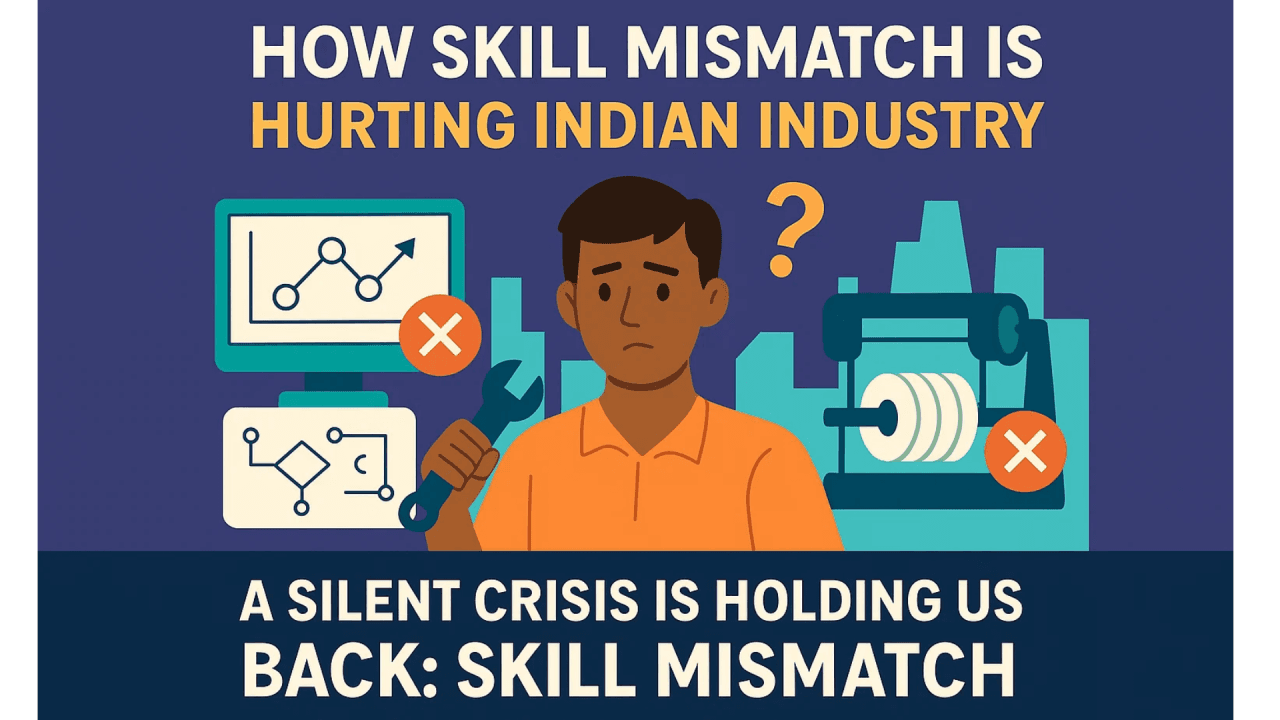
Introduction: The Paradox of a Young Workforce and Stagnant Output
India is often celebrated for its demographic dividend—over 62% of its population is aged between 15 and 59 years, and the country adds more than 12 million people to its working-age population every year. This should, in theory, provide a powerful engine for economic growth, innovation, and global competitiveness.
Yet, Indian industries continue to grapple with a troubling paradox: despite an abundant labor force, there is a persistent scarcity of job-ready talent. From manufacturing and construction to IT services and healthcare, companies report that vacancies are going unfilled—not because people aren't available, but because they lack the right skills.
At the root of this disconnect lies a systemic problem known as skill mismatch—a misalignment between what job seekers can do and what industries require. This mismatch doesn’t just limit individual career growth; it drags down entire industries through rework, inefficiencies, high attrition, inflated training costs, and missed opportunities.
As India pursues its ambition to become a $5 trillion economy, bridging the skill gap has become an economic imperative. This blog explores the wide-ranging impact of skill mismatch, why it persists, and how we can fix it—turning India’s youth into a strategic advantage rather than a lost opportunity.
The Real Costs of Skill Mismatch on Indian Industry
1. Productivity Losses and Rising Operational Costs
When employees don’t possess the skills required for their roles, productivity takes a nosedive. This leads to
- Rework and Errors: In manufacturing and IT, employees lacking precision and knowledge often produce defective work that needs to be redone. According to NASSCOM, rework can account for 15–30% of operational costs in sectors like IT services and manufacturing.
- Delays in Delivery Timelines: Projects stretch beyond deadlines due to repeated revisions, retraining, and task reallocation. This makes Indian firms less reliable in global outsourcing markets.
- Increased Supervision and Micromanagement: Team leaders spend significant time correcting mistakes, conducting quality checks, and guiding underprepared staff—time that could be spent on strategic growth.
- Poor Service and Product Quality: Low-skill performance directly affects customer satisfaction and brand trust. In retail, healthcare, and hospitality, this can lead to reputation loss and declining customer loyalty.
Case in Point: TeamLease Services found that over 80% of engineering graduates in India are unemployable in the IT sector due to lack of practical skills, prompting tech firms to spend up to ₹2–3 lakh per hire on remedial training.
2. High Attrition, Low Retention, and a Shrinking Talent Pool
Skill mismatch not only affects productivity—it also fuels India’s rising attrition crisis.
- Employees hired for roles they’re not suited for often experience stress, dissatisfaction, and poor performance, prompting them to leave quickly.
- Companies spend months on hiring and onboarding, only to find themselves repeating the cycle within a year.
- In high-growth sectors such as AI, fintech, cybersecurity, and advanced manufacturing, the shortage of skilled talent is particularly acute—despite millions being unemployed.
Insight: The Indian IT industry faces an average annual attrition rate of 20–25%, with many exits linked to skill-related job dissatisfaction or the lure of upskilling opportunities at other firms (Economic Times).
3. Innovation Deficit and Reduced Global Competitiveness
Skill mismatch doesn’t only affect current operations—it undermines a company’s ability to evolve.
- India’s global competitors are upskilling faster. Countries like Vietnam, the Philippines, and Poland are grabbing contracts in BPO and ITES sectors once dominated by India, largely due to superior vocational training systems.
- Only about 5% of India’s workforce is formally skilled, compared to 50% in China and 75% in Germany (World Bank, 2021).
- Without workforce readiness for AI, data analytics, machine learning, robotics, and green manufacturing, India risks falling behind in the global race for innovation.
Why the Problem Persists: Root Causes of Skill Mismatch
1. Outdated Academic Curriculums and Pedagogy
- Most colleges still teach outdated content—programming languages that are no longer in demand, business models that ignore digital transformation, and mechanical engineering practices that don’t align with smart factories.
- Rote learning dominates, leaving students with theoretical knowledge but poor problem-solving, communication, or team collaboration skills.
- Lack of industry partnerships means graduates don’t gain exposure to real-world challenges before entering the workforce.
McKinsey Insight: Just 40% of Indian employers believe that university graduates are adequately prepared for entry-level roles.
2. Fast-Paced Technological Change
- The speed at which technology evolves outpaces the ability of employees—and often entire industries—to keep up.
- Mid-career professionals face obsolescence without access to affordable and relevant training.
- There’s a shortage of instructors who are themselves trained in new-age tools like Python, AI/ML, blockchain, or cloud computing.
3. Underinvestment in Employee Development by Employers
- Many companies—especially MSMEs—view training as a cost, not an investment.
- Training is often generic and not tailored to job roles.
- There are few structured pathways for an employee to move from low-skill to high-skill work through in-house learning and development.
Solving the Skill Mismatch Crisis: What Can Be Done?
1. Education System Overhaul: From Theory to Practice
- Apprenticeships and Internships Must Be Mandatory: Every degree should include a hands-on component—modeled after Germany’s dual education system.
- Curriculum Revamp: Industry bodies (e.g., NASSCOM, CII) should collaborate with universities to co-create future-ready programs.
- Early Skill Exposure: Encourage vocational and STEM learning from secondary school onwards, aligned with National Education Policy 2020.
2. Government-Led Interventions at Scale
- Revamp Skill India 2.0: Focus on not just low-skill but high-skill domains—robotics, AI, biotech, renewable energy, etc.
- Strengthen NAPS (National Apprenticeship Promotion Scheme) with incentives for companies that onboard and retain apprentices.
- Launch National Digital University as a credible platform offering micro-credentials, bridging the learning gap between academia and industry.
3. Corporate Strategy: Treat Learning as a Growth Lever
- Invest in Tailored Learning Platforms: Adopt Coursera, LinkedIn Learning, and UpGrad for personalized training.
- Micro-Credentials & Internal Certifications: Employees can collect digital badges, verified certificates, and pathway-based promotions.
- Create In-House Academies: Firms like Infosys and Capgemini have shown how internal learning ecosystems can support long-term productivity.
4. Culture Shift: Make Lifelong Learning the Norm
- Empower Individuals: Encourage employees to take responsibility for learning through time-off for training, study stipends, and peer mentoring.
- Reward Learning: Incentivize skill development through appraisals, certifications, and visible growth trajectories.
- Promote Peer Learning: Learning doesn't always need to be top-down; internal communities and mentorship groups can accelerate knowledge-sharing.
Global Models India Can Learn From
Germany: The Dual Vocational Training System
- 85% of students undergo vocational training that blends academic and workplace learning.
- Training is industry-aligned, ensuring that young workers are productive immediately upon joining.
Singapore: The SkillsFuture Initiative
- Citizens receive learning credits to invest in upskilling throughout their lives.
- The initiative has reskilled over 500,000 people annually in emerging technologies, helping Singapore stay globally competitive despite its small workforce.
Conclusion: From Mismatch to Momentum
Skill mismatch is no longer a fringe issue. It is a critical bottleneck threatening India’s economic progress, industrial competitiveness, and global positioning.
With nearly 50% of India’s workforce projected to need reskilling by 2025 (World Economic Forum), bold action is required—not just from the government, but from academia, industry, and workers themselves.
The Way Forward:
✅ Revamp curriculum through industry-academia alignment.
✅ Scale digital and vocational skilling through government programs.
✅ Drive corporate learning investments and internal L&D ecosystems
✅ Foster a national culture of self-driven, lifelong learning
If we can realign skills with industry needs, we won’t just be preparing India’s workforce for jobs—we’ll be preparing them to create the jobs of the future.
What’s Your Take?
How do you think India can effectively bridge the skill gap? What reforms do you think are most urgent? Share your thoughts in the comments below.
RECENT BLOGS
- Why Skilling Is the Strongest Investment Leaders Can Make in Their People?
- From Labor-Intensive to Skill-Intensive: Transforming India’s Manufacturing Workforce
- Scaling Soulfully: How an Indian Artisan Brand Scaled 5X Without Losing Its Agility (An Anantamitra Blueprint)
- Bridging India’s Skill Gap: Why Industry-Led Training Must Become a Governance Priority
- Forging Our Future: Skilling as the Engine of Sustainable and Inclusive Manufacturing
- Why Indian Manufacturing Needs a Skilling Revolution—Not Just More Workers Introduction India’s manufacturing sector is often hailed as the cornersto
- From Rework to Results: How Skill Mismatch Is Hurting Indian Industry